
I am an environmentally-conscious person. Not currently as much as I used to be — I drive my car more now than I ride my bike, and I use way too many paper towels. And I’ve never been as environmentally conscious as I’ve wanted to be.
But I keep trying. And I believe in my responsibility to pass along my care for the earth to my kids. I mean, how about that saying, “Everyone talks about leaving a better planet for our kids. How about let’s try to leave better kids for our planet.”
Truth. Those damn Happy Meal toys that I picture piling up into a planet of their own. So much waste at holidays and during celebrations. I mean, I’ve been right in the thick of it too – let’s buy the new things, let’s wrap them in new paper, let’s put up the new decorations. I do keep as much as I can and reuse all of the time. I donate whatever I can or sell on Facebook Marketplace. Hopefully watching me do these things will rub off onto my kids. But, we live in a buy now, buy everything world. Consumerism is suffused into our daily lives. And it’s been hard to turn that off.
I want to build better habits as a family. (And habits that include much more than scrubbing clean all of those peanut butter jars.) So I turned to Pallavi Pande, owner of the sustainable disposable tableware company DTOCS, and mother of two, to talk with her about how she is raising sustainable kids. Here is a link to our podcast conversation if you’d like to take a listen.
What stood out the most from my conversation with Pallavi was that we are the model for our children in this, just as we are in everything else. They are watching, they will absorb it. “My mom used to say monkey see, monkey do. It’s like, no matter what you tell your kids, they will only do it when they see it,” Pallavi says. “And that is something that really stood by me, that if I have to role model something, I have to do it, not just start it and leave it, but I have to finish it through. Or if I can’t, I have to give them the right reasons. Or why is this not something that matters to me? Or maybe that value is different for me and different for them. So I want to give them that reasoning and it was just much easier to role model and teach them versus tell them a hundred times and not see follow-through.”
I agree. I mean, our children will pick up habits outside of the home. Like in school, they’ll learn about sustainability, they’ll learn what to put in which recycling bin. We have a teacher in our school who collects compost in her classroom. But so much also happens in our own homes. We still ride bikes often as a family, but I used to take the kids everywhere on a bike — to school, to the library, to the park, to grocery shop. (We have a bike trailer. 😊) If I get back to this habit, my kids will grow up seeing this as a totally normal (and extremely fun) way of getting around. If I stop using all of these paper towels and get back into reusable cloths, my kids will see how to clean them, how many you’d need in a home, how easy it can be to replace paper towels with alternatives. If I start to put foods in a compost system, my kids will feel more comfortable doing that in their own homes when they get older.
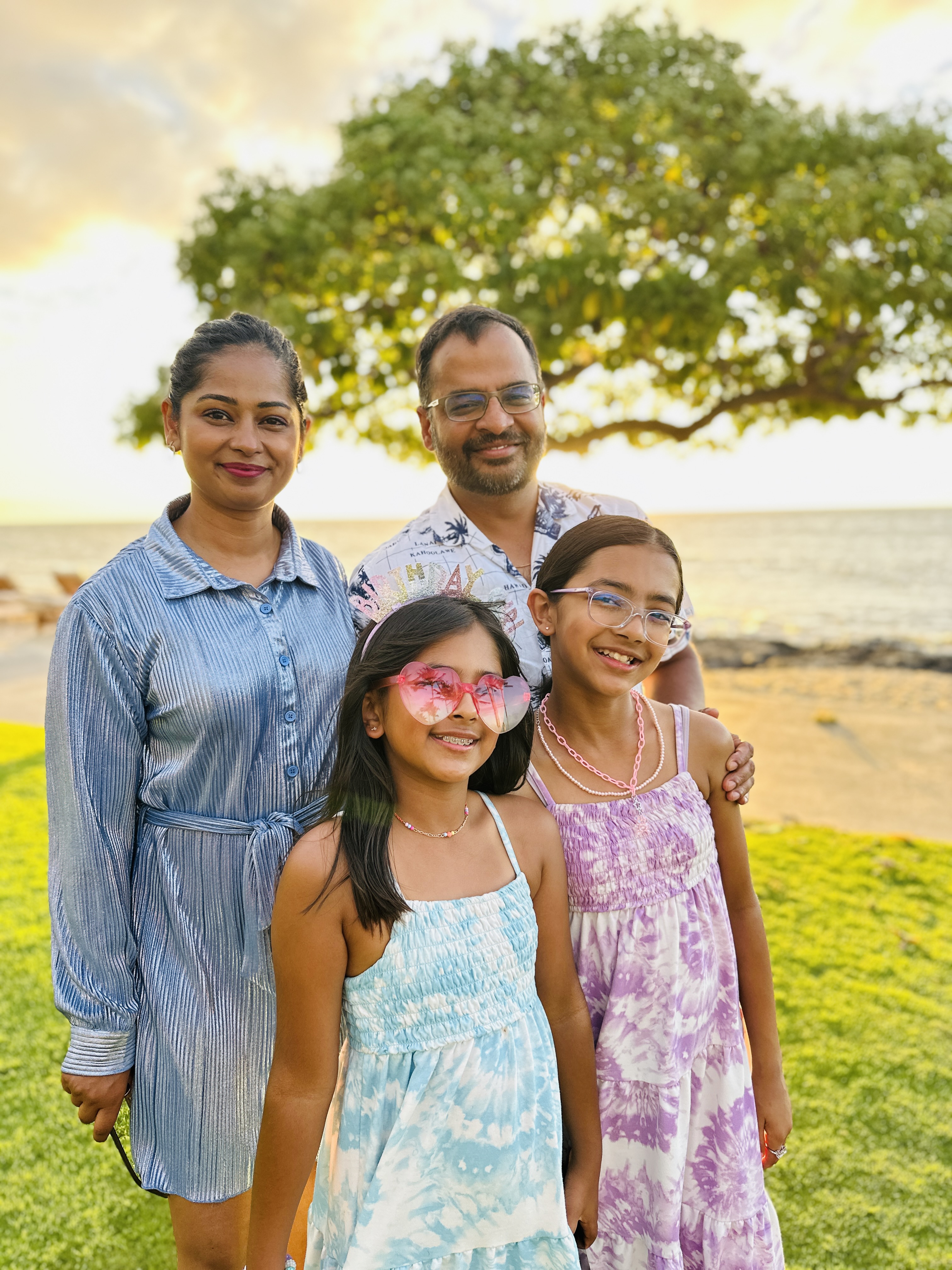
Pallavi’s daughters have grown up around their mom running a sustainable business, so for them, this stuff is becoming second nature. “They’ve been advocating for us for the last [five years],” says Pallavi of her 10-and-12-year-old daughters. “They now understand that every plate has a story and they love knowing that our plates are made from leaves and that we save trees and it’s like running a bedtime story in their head with just an eco-friendly twist.” Pallavi says that her daughters have genuinely embraced the business over the years, and if you take a look at DTOCS’ socials, you’ll see the cutest, most environmentally-minded brand ambassadors. “I don’t have to tell them, please do this, please do that. It just comes inherently because they’ve been seeing me do all this,” says Pallavi.
What’s important is to start somewhere, whatever that looks like for you, and then slowly build the habits. “It’s not something you wake up to one day and say, oh, I want to be sustainable today. It’s not that jazz word. It’s something you practice. And that’s what I tell my kids. Sustainability is an art of practicing something every day. And you can start it small. You just have to see if you can keep through it. And you really find out more about yourself when you’re on this journey. What is something that you would love to change and adapt to bring sustainability into your life?” Pallavi explains. “You really have to find what values you align with.”
While Pallavi and her family practice sustainability on many levels, for families looking for a small change to start with today, she suggests tasks like washing plastic baggies to reuse them and saving paper from mail to use for art projects with the kids. (Pallavi even uses the blank sides of her mail for DTOCS’ mailing labels! That is sustainability through and through!)
She finds that once the ball is rolling, kids start to get into the mindset as well. “The kids also started questioning, ‘Why is it like this?’ Or, ‘Why are you doing it this way?’ Or, ‘How can we do this better?’ And then having them think through that was a big advantage to incorporating sustainability in our lives and finding out ways of how we can do everything better every day,” says Pallavi.
As Pallavi says, it’s a gradual process. Start with something simple and give your children guidance to follow. The habit will eventually be built.
The focus on reusing our materials is really important too because as Pallavi and I discussed, not much of what we put in the recycling bin actually gets recycled. “Everybody should know this, like only one to two percent of items in the United States gets recycled,” Pallavi explains. (Those peanut butter jars I’ve worked so hard on!)
So we need to figure out other habits to build. Namely, we need to stop buying so much stuff. I’ve entertained the idea of experiences as gifts for many years now. And I was really good at being thrifty with toys with my first child but then it snowballed once the next three were born, and it snowballed at an incredibly fast rate.
For Pallavi, it was cleaning up all of the clutter that was her ah ha moment. “I realized, oh, my God, look at this clutter. Like we don’t need it. So that’s when we quickly pivoted into experience gifts, because that is something that could be here [in your heart] and you can keep as much as you want here [in your mind],” says Pallavi.
I wondered what that change was like for her though. I often imagine a grand scale revolt from my children if there are only envelopes and explanations under the Christmas tree. (Even though this is truly my dream.) “Of course it was hard for them to dissociate with things because this still happens today. My kids are in middle school. So with the middle school friends and the makeup and the Stanleys … you really have to be aligned in that thinking to think, ‘Oh, okay, mom, I think I’m fine. I don’t need this,’” says Pallavi. She explains that her 12-year-old is finding it easier to have a minimalist approach as she gets older but that her 10-year-old is still focused on trends. Her main goal is to always give them time to think about something when they’ve asked for it and offer them an incentive for an alternative, such as a gift card, an experience, or money to spend on an upcoming trip. “That’s where you bring up the concept of need versus want before you buy it. Tying all those deeper meaningful discussions over things like this,” says Pallavi. “Whenever I see an opportunity, I dive into it. Like, why do you think that? Tell me more? Like curiosity and actually showing them how they can be more responsible.”
Pallavi is also working with her daughters’ mindsets on reusing and repurposing used clothing. “We love Goodwill. That’s a place where we go to find secondhand treasures because repurposing, giving things another usage, is very dear to me — that’s the whole concept of [DTOCS].” Pallavi also runs a Facebook private community based in Portland, Oregon called Brown Mommies, and in this group they have a clothing box. “It’s full of Indian, Asian, ethnic clothes rotating from every household. And my kids have used so many clothes from it, like amazing, beautiful clothes. Some of them are secondhand, some of them are firsthand, even with tags. I have repurposed so much clothing from there,” says Pallavi. And while sometimes her girls really want something new from a shop, Pallavi keeps showing them the alternatives. “Again, role modeling and really teaching them that it’s okay to reuse, it’s okay to repurpose, and just showing them how to do it because they might feel embarrassed doing it. But if you’re the one starting it, it might not happen the first time, but if they see you maybe five times, they’ll be like, okay, show me what’s there. They might not even wear it the fifth time. Maybe it’ll take the 10th time for them to have the courage to wear something from that repurpose box.”
Again, it comes back to doing it first so that your kids can understand and get comfortable with how it’s done. It’s how our kids learn everything — from watching the world around them, and specifically from watching the people closest to them.
And each time you are engaged in showing your child a new way of doing something, take a moment to deepen the conversation. “You can always bring up conversations like, ‘Have you wondered if you would have thrown this tissue box in the trash, where would this go?’ Ask those deeper connection questions,” says Pallavi. “Make them think, because the thing is they want to be part of the impact. That’s the power you’re giving to them. That’s your eco-parenting game.”
Thank you Pallavi!
Follow along with Pallavi, her family, and DTOCS on their Instagram page, and shop for your own set of DTOCS single-use dinnerware at https://dtocs.com. They ship to the US and Canada! Pallavi shared the code DTOCS10 for 10% off your first order plus free shipping.


 Little Tot Landing