
My older kids are at just the right age where existential questions pop out of nowhere on the daily — while I’m figuring out if I already added salt to a dish, if we’re late driving to an appointment, when we’re laying down, eyelids heavy, almost asleep.
They encounter countless perspectives and experiences these days — they are out in the world! And it’s great that they are exposed. And it’s great that they have questions, even though I don’t always have the answers.
My faith is something I can’t fully define. It has evolved throughout my life, shaped by my experiences and what I’ve been exposed to, and I believe my husband has had a similar path.
I had the chance to speak with Steve Ghikadis, a freethinker married to a Christian who gives talks on parenting in an interfaith marriage, for episode five of the Little Tot Landing podcast. It was an enlightening and empowering conversation. I have felt, a little bit, that I have needed to have more concrete answers for my children and their existential questions but reflecting on my conversation with Steve, I appreciate that we can share with our children what we believe, others in their lives can share what they believe and our children will be OK because they are allowed to come to their own conclusions about their existence as they grow, learn, absorb and experience the world.
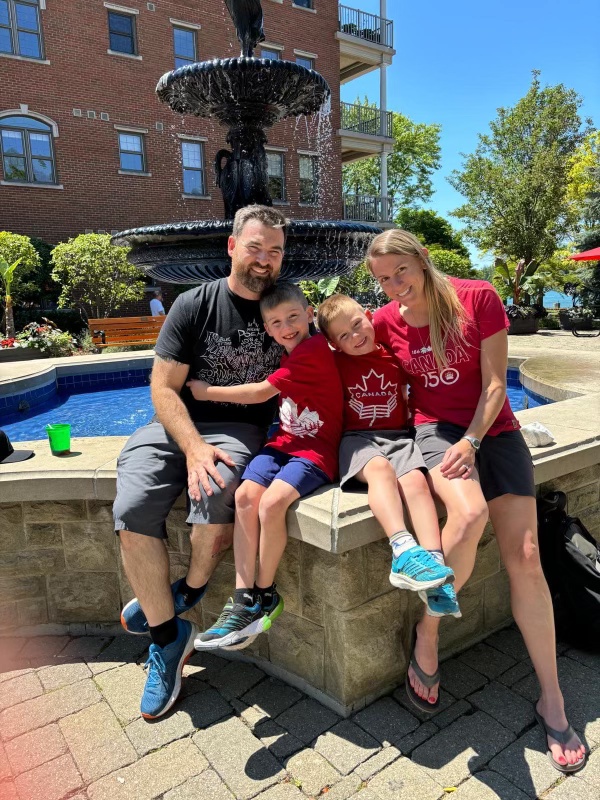
Steve and his wife Cindy believe in the importance of bridging the gap between believers and non-believers and are raising their two young children Nathan and Connor in an interfaith household. The boys are encouraged to explore their own beliefs freely, without being pushed toward any specific path. “I was raised as a free thinker. My mom accidentally did all of the right things to allow me to get to the worldview that I’m at now. And she did it accidentally, I say, because she didn’t read the book because there was no book at the time. She allowed us to question things all the time. We had friend groups that were all different religions and we kind of grew up in a melting pot area,” Steve says.
Steve and Cindy have worked through having differing worldviews throughout their 10 years of marriage and their years of dating. Initially, Steve would attend church with Cindy’s family and kept any thoughts about a different worldview to himself. It wasn’t until after they were married in a religious ceremony at Cindy’s family church that Steve felt he needed to come forward. “I felt like a wolf in sheep’s clothing,” says Steve. He slowly stopped going to church and started to discover outlets that fit more with his worldview.
“The first thing I found was Anthony Magnabosco who practices street epistemology … which is basically Socratic questioning to ask people how they got to believe what they believe,” says Steve. This Socratic questioning helped Steve as he worked to repair his wife’s trust and navigate their relationship as two people with two different belief systems. “Instead of saying to her something negative about the religion, I would just say, ‘Well, why do you think this is the way it is?’ Or, ‘Why do you think this?’ Honest questions, curious questions,” says Steve. “And that opens up to exploring more or even just stating more about what she believed. It enabled me to see her as more of a human than the idea itself.” Steve also found Dale McGowan, whose book, In Faith and in Doubt, helped Steve navigate this new territory. “Dale McGowan has been a personal hero of mine. Same with Anthony Magnabosco. I reached out to both of them and they’ve both been helping me for eight or nine years. We’ll share information back and forth even to this day about my situation, their situations. Everything. They really helped me find that balance of how to speak respectfully and find a common middle ground,” says Steve.
When Steve and Cindy were pregnant with their first child, they were at a place in their marriage where communication was respectful and understanding was valued. “We decided together that we were going to allow the kids to choose their own beliefs,” says Steve. “Now to me, I don’t feel like you can choose beliefs, I think you’re either convinced or you’re not, but having the opportunity to explore and then come to a conclusion — and when I say conclusion, nothing is ever set in stone. That’s the cool part, right? You can change your beliefs a million times if you want and there’s no consequences for getting it wrong. And that gets into the nine best practices [of raising a freethinker],” says Steve.
Steve’s nine best practices for raising a free thinker come from Dale McGowan’s podcast, Raising Freethinkers.
Leaving the Kids Unlabeled: “If you put a label on them, they’re going to feel like they have this big thing that they need to live up to and they don’t even know what it is,” says Steve. “If you just tell them one specific thing and don’t give them the option to learn about others or to question, that’s indoctrination. You should have influence on your kids. They should see the way that you interact in the world, how you interact with people, how you solve problems and that will be influence … Just leave them unlabeled and they’ll figure it out for themselves.”
Encouraging Curiosity: “The biggest thing you want your kids to hear on a regular basis is you saying, ‘Wow, wow, look at that sky. Wow, look at that flower. Wow, look at that tree. I wonder how it grows like that?’ Or, ‘Wow, look at these bugs, they’re so different from each other. Why do you think that is?’ Encouraging that curiosity will keep them going through the rest of their lives. Curiosity is probably the number one thing. Dale McGowan always says that if he could implant anything in his kids, it would be endless curiosity because from curiosity you get critical thinking, you get exploration, you get kindness because you’re actually trying to put your yourself in their shoes and say, you know, what is this person experiencing? Which leads to empathy, because then you’re like, okay, that person over there looks sad. Why are they sad? What could I do to help? That type of thing. Curiosity is the thing that really drives everything.”
Encouraging Empathy: “Empathy is a natural thing that comes about from curiosity. But again, if you can say, ‘Look at mom, she looks really sad right now,’ you can [encourage empathy] by pointing out things. You can say, ‘What do you think that person over there is feeling right now?’ Or, ‘Look at the look on their face.’ Or, ‘How do you think you made your brother feel when you did that?’ That type of thing. … The difference between sympathy and empathy is that empathy is when you actually feel the pain that someone else is feeling and sympathy is more feeling sorry for that person from a distance.”
Active Moral Development: “Active moral development is basically when you can notice the empathy. That’s when you can use empathy to find out what the consequences are for things. So, you know, I’m going to help mom and I’m going to feel really good because I helped mom and then that feeling is going to encourage you to once again seek out that feeling. And that’s a cyclical thing. If you feel the empathy for people and you see their face, you can see if you can help them, and what the consequences for that would be. It’s like if you go and help someone get across the street and then they give you a thank you or they give you a smile, you feel that goodness that you’re doing. And that’s a kind of reward in itself. So they’re kind of rewarded for good behavior and just doing it naturally from that perspective.”
Religious Literacy: “Nathan’s really taken humanism and ran with it. … And he was in the Christmas play at my wife’s church last Christmas. … [It’s important] to learn about the different religions, especially the ones that are prominent in your culture. A few years ago, there was a politician who when asked what his favorite book of the new Testament was, he said Job, which is in the old Testament. So he lost all the Christian voters right away. And all of the Jewish voters that were like, Hey, that’s part of the Tanakh basically. And so he lost all those votes and basically went into obscurity because he didn’t know the culture. He didn’t know what he was talking about when it came to that. It’s big to know who you’re talking about and what you’re talking about. So someone says, have you heard of Jesus? And you go, ‘Who?’ You know, that’s going to be a big shock, right? … Religious literacy is ensuring that [your children] are getting their questions answered when it comes to different religions and even experiencing or exposing them to different religions.”
Engaged Coexistence: “This is coexisting with someone else who is of another religion. We have a lot of experiences like this too because the boys will ask me, ‘What’s that person wearing over there?’ And I’m like, ‘Oh, that person’s a Muslim and it’s a hijab. And the reason why they’re wearing it is because it makes them feel like they’re closer to their God. And they’re being respectful of their God.’ And they go, ‘Well, what do you mean by respectful of their God?’ I’m like, ‘Well, in some cultures, they feel that they need to cover their skin, to respect their God.’ And then they get a little bit more curious. So then I’m like, ‘Oh, I don’t know any more than that. We’ll have to Google it.’ And then we can learn together. We don’t have to know all the answers. … And, I have the privilege of having [engaged coexistence] in the home. The boys have engaged coexistence right in front of them all the time. So, I’m going to refrain from saying something that might be harmful or hurtful to Cindy and she’s going to do the same thing for me because we don’t want to hurt each other. … [The boys] witness us having conversations in a lighthearted and openhearted way.”
Questioning Authority: “I don’t want to ever say to [my kids], go to bed because I said so. I want them to say like, ‘Oh, why are we going to bed at this time?’ I’ll say, ‘Oh, it’s time for bed.’ ‘Why?’ ‘Because, you know, if you don’t get some sleep, then you’re going to be grumpy in the morning.’ … You know, you give them an explanation, which is the authoritarian versus authoritative parenting. So authoritarian parenting is the bad one. Authoritarian is basically do it because I said so. It’s the, I’m going to come up with the rules and you’re going to follow the rules to a T. Authoritative parenting with the V — you can remember it’s the V one because love also has a V in it — is more like you kind of can make the rules with them. It’s kind of a collaborative effort on making the rules. It’s like, okay, well bedtime is at this time. And then if they come up and say, ‘I want an extra 10 minutes,’ it’s like, well, ‘Why do you want an extra 10 minutes?’ ‘Well, because I need to do this, this, this, and this.’ And then you can, on a day-to-day basis or on a time-by-time basis, you can say, ‘Okay, that makes sense.’ You know, okay, you can have another 10 minutes or whatever, and it gives them the authority to kind of push back. Because the thing that you want to avoid is if someone comes up to them and says, ‘Here, come to me in this back room,’ you want them to say, ‘Why?’ Or you want them to say, ‘I’m going to go tell my parents, or ask my parents.’ You don’t want them to just follow along because you have to follow authority. Encourage them or invite them to ask you questions on why you’re making a certain decision and never just say, ‘You’re doing this because I said so.’”
Making Death Natural and Familiar: “This one is unfortunate but it’s going to come up and it’s going to come up when people in your family pass. It’s going to come up when pets pass. And that’s a really tough subject, especially [for someone like me] who’s non religious. I don’t have the luxury of telling [my kids] that [the deceased is] in a better place. Which, you know, religious people sometimes think that is a nice thing to say, they’re in a better place. [But sometimes] you’re thinking, how can they be in a better place if I’m not there, you know? So to me, it’s easy because I can explain to them that life is a gift because it’s so short and because we only have so much time, let’s make the best of the time that we have. And then it’s like, you know, death is a part of life. Death is a thing that happens to every living creature and every living being. And, we’re going to be part of the stars again, one day. We are made of stardust. That’s all the elements that were cooked inside stars, billions of years ago, it’s all inside our bodies flowing. So we’re eventually going to be part of the stars again, one day.”
Normalizing Disbelief: “The biggest thing is that some people will hide their disbelief and it’s not for their fault, right? It’s just that maybe they’re in a situation where they cannot come out as an non-believer because they might be in some countries like in the middle east where they’ll be executed if they come out as a non-believer. … I’m in a privileged position where I can come out as a non-believer and there’s not any consequences against me. But there’s a lot of people who can’t. … It’s important to normalize that non-belief because like you said, when that girl [in your university religion class] realized that all of these people have different worldviews and she said I’ve never experienced this before — if you can show people that it’s okay to not believe as well, then they know that’s an option. When they’re questioning and they think, I can’t believe in this God thing that they keep talking about, what can I do? It’s like, it’s okay to not believe — there are people out there who don’t believe.”
As we spoke, Steve also discussed the Platinum Rule vs. the Golden Rule, which I think is a really important distinction to make that helps guide the above nine best practices. “Pretty much every religion that has ever existed has some sort of Golden Rule. It’s always essentially treat others the way that you want to be treated, or something along those lines. We have [a children’s] book called Elle the Humanist and it doesn’t disparage religion at all in it, it just talks about how humanism kind of coincides with religion. It shows a big chart of all the different religions that have a similar message but then it says that the best one — and I’m biased here because I’m a humanist — but the best one would be the Platinum Rule, which is to treat others the way they want to be treated. You don’t always want to treat someone the way that you want to be treated because everybody’s different. So the best thing to do would be to use all those skills that you have, like empathy, and you want to be able to say, what does this person need and how can I get that for them? You know, as opposed to, this is what I want. Like, I want pizza, so I’m going to make sure that someone else gets pizza. It’s like, well, maybe someone is allergic to cheese on a pizza, or whatever. It’s simple things like that but it could get into more complex things, right? … I think that’s partly the problem with what’s happening in the world with the 2SLGBTQIA community. They’ve been treated the way that people want them to be treated, not the way that they actually want to be treated. So now they’re speaking out, like, okay, we’re here and this is the way we want to be treated,” says Steve. “And that is why the platinum rule is so important because if you treat people the way they want to be treated then you don’t have to worry about it. You just think, OK, how would this person want to be treated from their perspective and you go, OK, well i’m just going to do that or i’m just going to leave them alone.”
Mutually respectful conversations are also a key component and are essential to model for your children. An example that Steve gave of this during our talk was when he and his family took a recent trip to the zoo. “Connor says, ‘Dad, why don’t you believe in God?’ I said, ‘Oh, well, I just don’t see any evidence that God exists.’ And he said, ‘But mom believes in God.’ And then I looked at her and I said, ‘Right?’ So then she goes, ‘Yeah, I do.’ And then he says, ‘Well, why do you believe in God?’ And she said, ‘Well, for me, it’s not evidence but it’s something that I really hope. And it’s something called faith, which I put a lot of trust and hope into.’” Steve says these conversations with and around the kids are always kept light. “It’s always a lot of love and always a lot of heart put into it. We always just try and show respect for each other’s worldview when these conversations come up.”
These mutually respectful conversations are also at the core of Steve and Cindy’s desire to bridge the gap between believers and non-believers. “A lot of times what we get at Recovering from Religion [an organization where I am an ambassador], are phone calls from people who are like, ‘I just realized that my beliefs are this and everybody else thinks differently than me and I can’t cope with that because everyone needs to believe what I believe.’ And then you talk through it with them like, ‘Why do people need to believe what you believe?’ ‘Well, you know, it’d make the world a better place.’ ‘Well, what are your core beliefs? What is it that you want to see happen in this world?’ ‘Well, I want everyone to work together.’ ‘Okay, well, does everyone have to believe the same thing to work together?’ And then they go, ‘No.’ And you’re like, ‘Okay. Right.’ Like you work through it and that is Socratic questioning. That is street epistemology. So if you can talk someone through their thinking — you’re not thinking for them — you’re helping them develop a plan to get to the goal that they want. You say, ‘What is it you want to see and how are we going to get there?’ And it’s like the main core thing is if you get down to it, your core beliefs —and this is the one thing when it came to Cindy and I’s marriage and how we’re raising kids — it’s like, we agree on 99 percent of everything. All the important stuff is covered. We just don’t agree on how the universe was created or came to be. And that’s like the smallest thing you could possibly even think of, right? Like, it’s cool to think about it but like nobody knows how the universe was created or came to be. So why argue over that, right? We’re here and we have to live in this world. We have to make the best of it.”
Resources
Looking to dig further into this topic? Steve offered up some great resources to check out.
Marriage
In Faith by Dale McGowan
Parenting
i) Parenting Beyond Belief by Dale McGowan
ii) Raising Freethinkers by Dale McGowan
iii) The podcast Raising Freethinkers which accompanies the book by the same title
iv) Relax, it’s Only God by Wendy Russell Thomas
For Your Kids
Elle the Humanist by Douglas Harris and Elle Harris
Stay in Touch
Follow Steve on Facebook or Instagram. Steve is the Ambassador Program Director for Recovering from Religion, an ambassador for Sunday Assembly Detroit and is also a Humanist Canada officiant. You can also reach him at the Windsor chapter of Humanist Canada by email at windsorchapter@humanistcanada.ca. Steve is currently working on his first book, Humanism From the Heart and his other writings can be found on Medium.

 Little Tot Landing